Everything to Know About Gummy Manufacturing
Gummy manufacturing looks straightforward — cook a syrup, deposit it into molds, let it set, pack it out. The reality is layered. The factory you choose determines whether your product holds texture across batches, clears customs without delays, and scales when your sales do. This page covers what B2B buyers should look at before signing a manufacturing agreement.
Starch Mogul vs Starchless Lines — and Why It Matters for Your Project
Most gummy factories run one of two production systems, and the difference shapes what they can actually make:
| System | Best For | Trade-offs |
|---|
| Starch Mogul | Classic gelatin gummies — bears, worms, rings, fruit shapes | Slower changeover, starch dust requires segregation for allergen-sensitive runs |
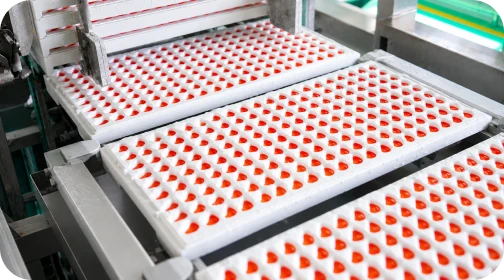
| Starchless (silicone mold) | 3D shapes, pectin, functional, fortified, brand-exclusive molds | Higher tooling cost per shape, faster sampling and changeover |
A factory limited to one system can't fully serve a multi-format brand program. Sweeto runs both, plus dedicated lines for filled, layered, and coated formats — which is what makes mixed-format development possible without rerouting orders to subcontractors.
The 7 Process Variables That Define Gummy Quality
Industry experience reduces gummy quality to a small number of measurable parameters. Every reputable factory should be able to tell you the target ranges they hold across batches:
- Cooking temperature — determines gel activation and flavor stability
- Brix level — controls texture, water activity, and shelf life (target 78–80°)
- pH — critical for pectin systems (target 3.5–4.5), affects gelation and microbial stability
- Water activity — drives shelf life and texture migration during transit
- Deposit temperature — too hot causes tailing, too cold causes incomplete fills (typically 75–85°C)
- Curing humidity — controlled at 30–40% RH for 24–72 hours
- Cooling rate — affects crystallization and surface integrity
Ask any factory you're evaluating for their target ranges on these seven variables. Specific numbers indicate process discipline. Vague answers indicate batch-by-batch inconsistency.
What Vertical Integration Actually Means for Buyers
"Vertically integrated" gets used loosely. The practical version is whether one factory handles formulation, mold tooling, production, QC, and packaging — or whether some of those steps are outsourced. Each handoff adds risk:
- Formulation outsourced means slower iteration, less accountability for stability
- Tooling outsourced means longer mold development cycles and version control issues
- QC outsourced means reactive testing, not in-line process control
- Packaging outsourced means a second supplier in the timeline, with separate lead time and damage liability
For brands managing multiple SKUs and tight launch windows, single-roof manufacturing isn't a marketing claim — it's the difference between a 45-day program and a 90-day program with three handoffs.
How to Audit a Gummy Factory Before Sourcing
Before committing to volumes, the questions worth asking aren't about the marketing pitch — they're about operational discipline. A short due-diligence checklist:
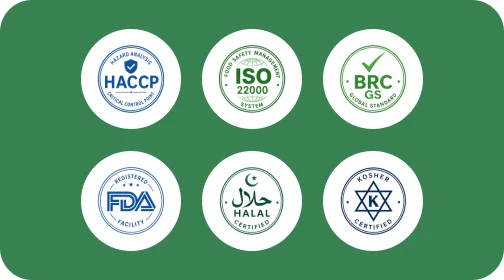
- Certifications — current HACCP, ISO 22000, BRC, FDA registration, plus market-specific (Halal, Kosher, Organic) as needed
- Batch records — ask to see SOPs and recent batch records. A factory that can't produce them on request likely isn't producing them at all.
- Capacity utilization — a factory at 95% capacity has no buffer for your peak season. Ask what their typical utilization runs.
- QC philosophy — in-house, third-party, or both? Reactive testing or in-line process control?
- Reference clients — ask for references in your market or category. Reluctance to share is a signal.
- Audit history — recent third-party audit reports (SGS, Bureau Veritas, Intertek) tell you what an outside auditor saw.
Compliance Documentation Across Markets
Customs delays at destination almost always trace back to incomplete documentation, not product issues. Different markets enforce different paperwork:
| Market | Required Documentation |
|---|
| EU / UK | BRCGS or IFS certification, allergen declarations, food-contact material compliance, multi-language labels |
| USA | FDA registration, Nutrition Facts panel, FSMA compliance, Prop 65 (California) |
| GCC / MENA | Halal certification, Arabic labeling, SASO conformity for Saudi Arabia |
| Southeast Asia | HACCP, Halal (Indonesia, Malaysia), country-specific health authority registration |
A manufacturer that doesn't actively manage your compliance documentation is leaving the riskiest part of the shipment to chance. Documentation should be assembled and validated before container loading — not requested after a shipment is held at port.
Capacity Planning and Seasonal Production
Gummy demand is highly seasonal. Halloween, Christmas, Valentine's, Easter, Ramadan, and Lunar New Year each pull production windows months in advance. Brands that submit volumes late get pushed to off-peak slots — or get told the line is full.
The practical timeline for seasonal programs:
- 8–10 weeks before peak shipping — submit forecast volumes, lock production slots
- 6–8 weeks before — finalize artwork, packaging, and any custom mold development
- 4–6 weeks before — production starts, with batch updates through completion
- 2–3 weeks before — final QC, third-party inspection, container loading
Factories with disciplined capacity planning can absorb this rhythm without compromising quality. Factories without it tend to push delivery dates or substitute formulations under pressure — both of which show up later as customer complaints.